Coromandel's best beaches, from Cathedral Cove to New Chums
Auckland: Cathedral cove coromandel scenic day tour
What is the most famous Coromandel beach?
Cathedral Cove, known for its dramatic natural rock archway, is the peninsula's signature beach — but it requires a 45-minute walk each way from the Hahei car park, or a water taxi, and gets genuinely crowded in summer.
The Coromandel’s beaches are worth the drive
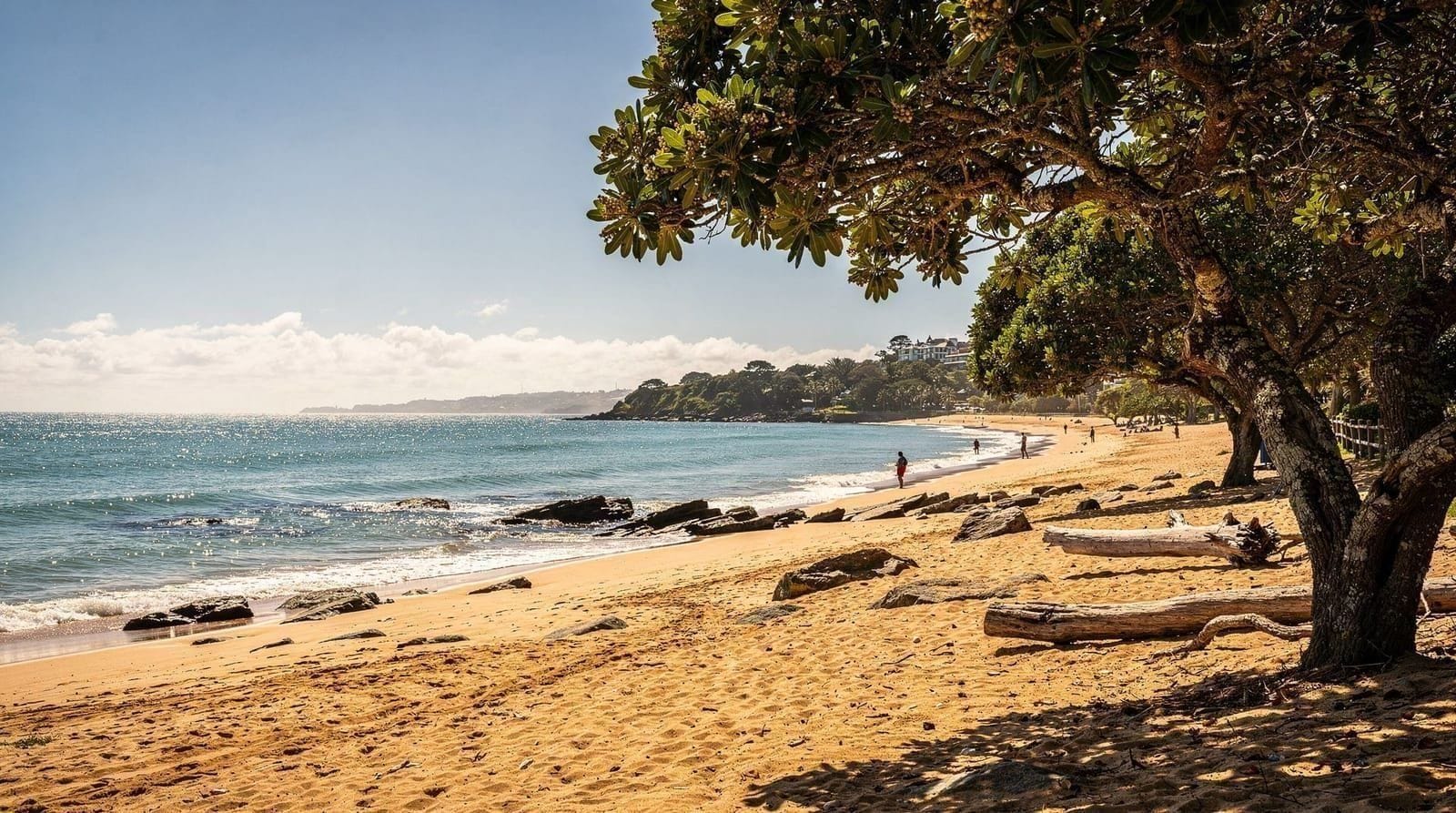
The Coromandel Peninsula, roughly 2.5-3 hours’ drive south-east of Auckland, has a genuinely different character from the city’s own coastline — pōhutukawa-fringed white and gold sand, dramatic sea-carved rock formations, and geothermal quirks you won’t find anywhere near Auckland itself. This guide ranks the peninsula’s best beaches so you can prioritise if you’re doing a single day trip or plan a longer stay if time allows.
The peninsula takes its English name from the kauri-spar buoys once loaded at Coromandel Town for the Royal Navy ship HMS Coromandel, but its Māori history runs much deeper. Ngāti Hei have lived around the Hahei coastline for centuries, and Cathedral Cove’s bay is properly Te Whanganui-A-Hei — the great bay of Hei — named for the navigator who explored this coastline generations before European contact. That history is worth carrying with you as you walk the tracks; several of the beaches below sit within land co-managed with local iwi, and the respectful Māori tourism guide has practical notes on visiting these places well, alongside our broader Māori heritage sites guide for the wider region.
| Where | Coromandel Peninsula, 2.5-3hrs SE of Auckland |
| Cost | Around NZD 80-150/couple self-drive (fuel, parking, spade) |
| Time needed | Full day for Cathedral Cove + Hot Water Beach |
| Getting there | Self-drive via SH25/Kopu-Hikuai Rd, or organised tour |
| Best time | Shoulder months (Mar-May, Sep-Nov) for warm water, thinner crowds |
Cathedral Cove — the icon
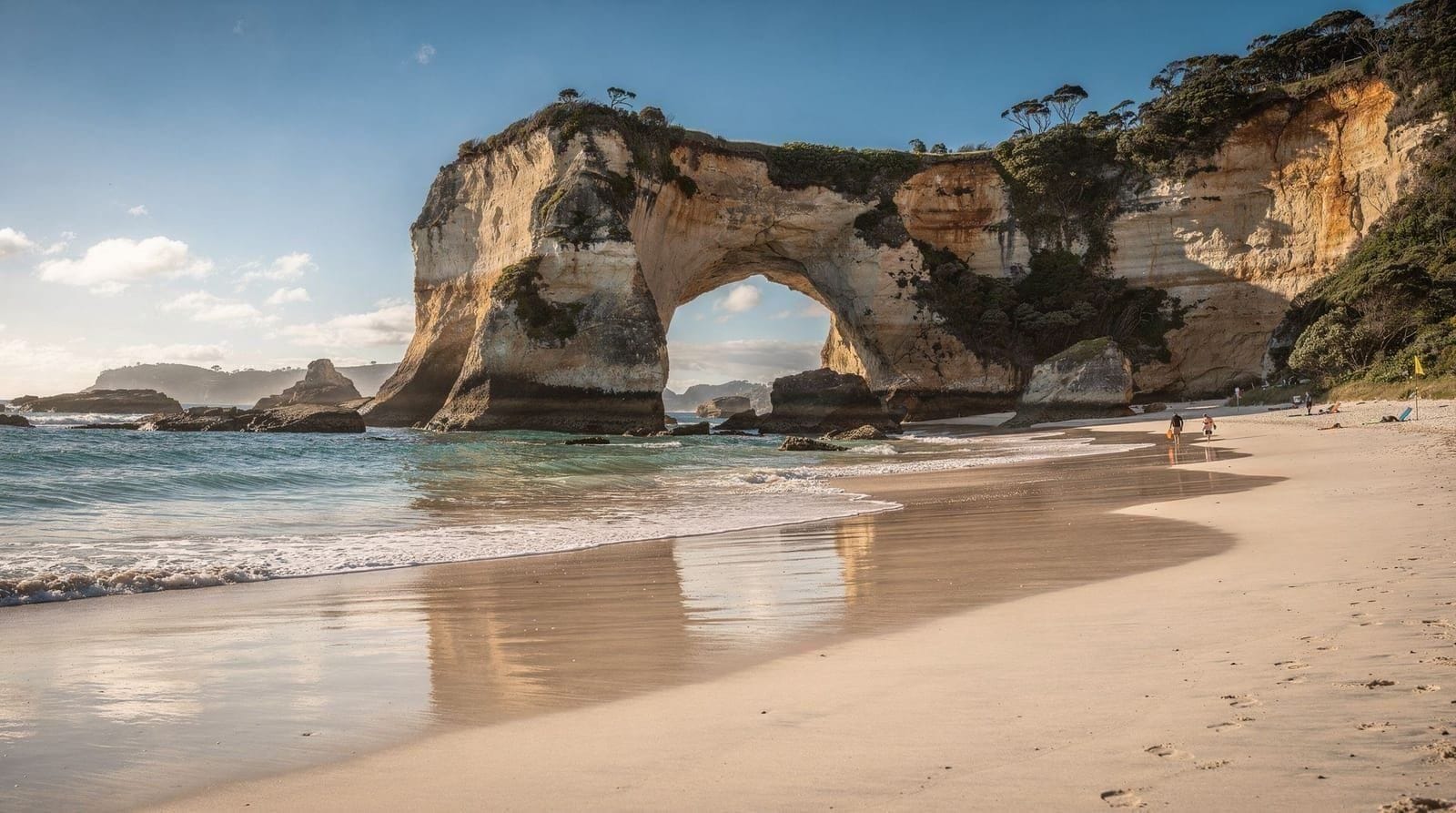
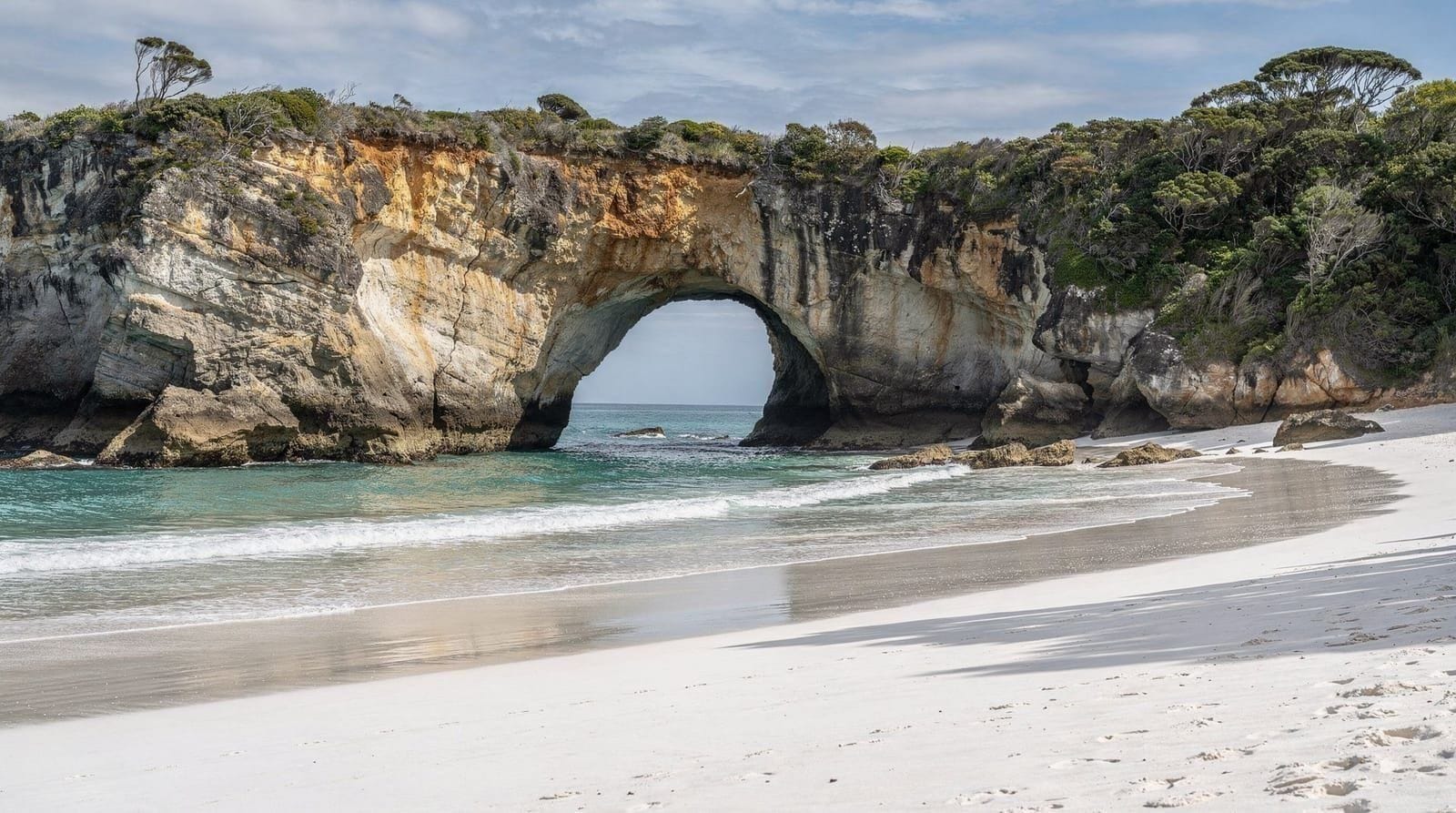
Cathedral Cove (Te Whanganui-A-Hei) is the Coromandel’s most photographed beach, named for the natural rock archway carved through a headland connecting two coves. It’s genuinely as striking in person as in photos, which is exactly why it draws crowds — expect a busy beach in peak summer, particularly around midday. Access is on foot only (unless you take a water taxi or kayak tour): a 45-minute walk each way, roughly 2.5-3km, from the Hahei car park, with a moderate climb over the headland before descending to the cove. Go early morning if you want the archway without a crowd of other visitors in every photo. We cover the trade-offs between this beach and its geothermal neighbour in detail in Cathedral Cove vs Hot Water Beach.
The track itself is unsealed, with steps and a genuine climb in both directions — it’s not stroller-friendly and not realistic for visitors with significant mobility limitations, though fit walkers of most ages manage it without trouble. There’s minimal shade for most of the route, so factor that into your water and sunscreen planning, particularly in summer. The Department of Conservation occasionally closes the track after heavy rain or slips, since the path crosses genuinely erosion-prone coastal cliffs; if you’re planning a trip around Cathedral Cove specifically, it’s worth checking DOC’s current track status a day or two before you go rather than assuming it’s always open.
Water taxis from Hahei Beach are the main alternative to walking, running regularly in summer and cutting the whole return trip to well under an hour including time at the cove, though they add a cost most walkers don’t need to pay and don’t run in poor weather. Kayak tours cover the same water route at a slower pace and let you paddle into sea caves along the way that the walking track doesn’t reach at all — a genuinely different way to experience the coastline, not just a shortcut.
Hot Water Beach — dig your own spa
A 15-minute drive from Hahei, Hot Water Beach has a genuinely unusual party trick: geothermal water rises through the sand in a specific zone, and visitors dig their own personal hot pools with a spade (bring or rent one locally) at low tide. The window is tight — roughly two hours either side of low tide, when the geothermal zone isn’t submerged — so check tide times before you go; arriving at the wrong tide means a normal beach with no hot pools to dig. The open-ocean side of the beach has real rip currents and limited lifeguard coverage, so treat swimming here with the same caution as any unpatrolled New Zealand beach.
Spade rental costs roughly NZD 10-15 for the day from shops right by the car park, cheap enough that renting rather than carrying your own is the practical choice for most visitors flying in. Budget an hour or two once you’re actually in the geothermal zone — digging a usable pool, letting it fill, and mixing the scalding-hot spring water with cooler seawater to a comfortable temperature all takes longer than first-timers expect.
The single most common mistake here is showing up at high tide expecting hot pools and finding only ordinary surf; the geothermal zone is fully submerged outside the low-tide window, so check tide tables (widely available online, and posted at the car park) before you commit to the drive. The second most common mistake is digging directly on top of someone else’s pool, or too close to it — space out along the marked zone, since the sand cools quickly once you move even a few metres away from an active spring.
New Chums Beach — the one with no road
Near Whangapoua on the peninsula’s east coast, New Chums Beach has repeatedly been named among the world’s best beaches by international travel outlets, precisely because it has no road access and essentially no development — reaching it requires a roughly 40-minute walk along the coast from Whangapoua (crossing a stream at low tide, or via a bush track at higher tide). The reward is a genuinely untouched crescent of white sand backed by pōhutukawa and native bush, usually far quieter than Cathedral Cove even in peak season, simply because the access effort filters out casual visitors.
There are no facilities at New Chums whatsoever — no toilets, no shop, no shade beyond what the pōhutukawa trees provide — so bring water, food and sun protection with you, and plan to carry out everything you carry in. The stream crossing near Whangapoua is straightforward at low tide but can be knee-deep or higher after rain or at high tide, so check conditions and wear shoes you don’t mind getting wet. Because there’s no vehicle access at all, New Chums also has no realistic option for visitors with mobility limitations; this is a beach for those willing and able to make the walk.
Hahei Beach
The town beach at Hahei itself, a short walk from where most Cathedral Cove trips begin, is a solid, easy option in its own right — calm, sandy, close to cafés and accommodation, and a good base if Cathedral Cove and Hot Water Beach are both on your list, since it sits roughly midway between them.
Hahei village itself has a genuine, if small, tourist infrastructure — a dairy, a couple of cafés, fish and chip options, and a range of accommodation from budget holiday parks to higher-end baches (New Zealand’s term for holiday houses), which makes it the sensible overnight base if you’re splitting Cathedral Cove and Hot Water Beach across two calmer days rather than rushing both in one.
Kuaotunu and Opito Bay
Further north on the peninsula, Kuaotunu and neighbouring Opito Bay are quieter, less touristed beaches favoured by New Zealanders with holiday houses in the area rather than international visitors doing a single day trip. Both are worth knowing about if you’re staying overnight on the peninsula and want an escape from the Cathedral Cove crowds, though they add meaningful driving time if you’re trying to see everything in a single day.
Other Coromandel beaches worth a mention
The peninsula has more coastline than any single trip can cover. Whitianga, a working town with a genuine local feel rather than a beach-resort atmosphere, sits across the harbour from Hahei and makes a practical fuel and grocery stop if you’re self-driving. Whangamata and Onemana, further south, are popular with domestic holidaymakers for their surf and summer atmosphere but sit well outside realistic day-trip range from Auckland — they’re better suited to visitors basing themselves on the peninsula for several days rather than those doing a single loop from the city. If your time on the Coromandel is genuinely limited to one day, none of these should displace Cathedral Cove, Hot Water Beach or Hahei from your plan, but they’re worth knowing about if you extend your stay.
If you only have one day
A single day from Auckland realistically fits two of the peninsula’s beaches well, not three or four.
The combination that works best for most visitors is Cathedral Cove in the morning (arrive at the Hahei car park by 8-9am to beat both the crowds and the day’s heat) followed by Hot Water Beach in the early afternoon, timed against that day’s low tide — check the tide table before you leave Auckland, since it determines your whole afternoon schedule. Hahei Beach itself can absorb any spare 20-30 minutes between the two, since it’s roughly the midpoint. Trying to add New Chums Beach to the same day is possible in theory but tight in practice: it sits a further 30-40 minutes’ drive north of Hahei, and by the time you’ve done the Cathedral Cove walk and dug a Hot Water Beach pool, most visitors are running low on both daylight and energy. If New Chums is a priority, it deserves either a dedicated day or a spot on an overnight itinerary instead.
Doing it as a day trip from Auckland
The full round trip to Cathedral Cove and Hot Water Beach from Auckland runs long — 2.5-3 hours’ drive each way plus the walk to Cathedral Cove and time at Hot Water Beach means a full, tiring day if you’re driving yourself. Many visitors find an organised tour genuinely reduces the stress: the Cathedral Cove and Coromandel scenic day tour covers the drive and the walk with a guide handling logistics, while the Cathedral Cove and Hot Water Beach day tour from Coromandel Town suits visitors already staying on the peninsula.
If you want both beaches from an Auckland base in one trip, the Coromandel day tour including Hot Water Beach combines them, and the Coromandel Peninsula day trip covers the wider region if you want scenic driving stops along the way too.
Parking at the Hahei car park for Cathedral Cove fills by mid-morning in summer and on any clear weekend — arriving after about 10am in peak season often means a walk from an overflow area well before you even start the actual track.
The drive itself runs via SH25 and the Kopu-Hikuai Road, a winding, hilly route that’s slower than the distance suggests; allow the full 2.5-3 hours rather than trying to compress it, and add extra buffer if you’re not used to driving on narrow, winding New Zealand roads (our driving in New Zealand guide covers what to expect). Fuel, a rental car for the day, and any parking costs typically run somewhere in the NZD 80-150 range depending on your vehicle and how much of the peninsula you cover, before food — worth weighing against an organised tour once you count your own time and stress as a cost too. Our car rental Auckland guide has more on renting for a trip like this.
If you’d rather manage your own pace, see our Coromandel day trip guide for a self-drive itinerary, or our self-drive vs tour comparison if you’re still deciding.
When to go
Peak summer (December-February) brings the warmest water and the biggest crowds — Cathedral Cove’s car park at Hahei fills by mid-morning on clear days. Shoulder seasons (March-May, September-November) offer a genuinely better trade-off: still-pleasant weather with noticeably fewer people, particularly on weekdays. Winter (June-August) is quieter still but cooler and wetter, better suited to walking and photography than swimming.
Breaking it down month by month: December and January are the hottest and busiest, coinciding with New Zealand’s own summer school holidays, so expect the Hahei car park to fill early most days and Cathedral Cove to feel genuinely crowded by late morning. February typically keeps the warm weather with slightly thinner crowds once school holidays end. March and April offer some of the best conditions of the year — water is still warm from summer, but visitor numbers drop noticeably, especially on weekdays. May through August is winter: cooler air and water temperatures (think light jacket weather, not swimming weather for most visitors), more rain days, but also the emptiest Cathedral Cove photos you’ll get all year, and Hot Water Beach’s hot pools feel considerably more appealing when the air is cold.
September and October are transitional, with more unpredictable weather but an improving crowds-to-conditions ratio. November starts warming up again ahead of the summer rush, generally with lighter crowds than December-February. For a broader picture of how this maps onto the rest of the country, see our Auckland weather by month and best time to visit Auckland guides — Coromandel’s pattern tracks closely with Auckland’s own seasons since they’re only a few hours apart.
If rain sets in on the day you’d planned for the beaches, don’t force it: the Cathedral Cove walk becomes genuinely slippery and less enjoyable in heavy rain, and Hot Water Beach loses much of its appeal when you’re digging in a downpour rather than sunbathing afterward. Rescheduling by a day, if your itinerary allows it, produces a meaningfully better experience than pushing through wet weather for the sake of a fixed plan.
What to bring
Sturdy walking shoes for the Cathedral Cove and New Chums walks (both involve uneven, sometimes muddy sections), a spade if you’re planning Hot Water Beach and don’t want to rent one on-site, and — as everywhere in New Zealand — SPF 50+ sunscreen given the country’s extreme UV levels, particularly relevant here since much of the Cathedral Cove walk has minimal shade.
Cash or a card for spade rental and parking, since not every operator on the peninsula takes every payment type; a reusable water bottle, since Hahei’s summer heat combined with the Cathedral Cove walk adds up to real dehydration risk; and swimwear you’re comfortable getting sandy, since digging a Hot Water Beach pool is a messier activity than a normal beach visit. If you’re travelling with young children, a light backpack carrier makes the Cathedral Cove walk considerably easier than a pushchair, which the track’s steps and uneven surface don’t really accommodate — see our kid-friendly beaches near Auckland guide for beaches that suit younger children more easily if the Coromandel walks feel like too much for your trip.
Accessibility notes
None of the peninsula’s standout beaches are genuinely wheelchair or mobility-scooter accessible. Cathedral Cove’s track has stairs and a sustained climb; New Chums requires a stream crossing and an unformed coastal path; even Hot Water Beach, while flatter, involves walking across soft, uneven sand to reach the geothermal zone, which is difficult for anyone using mobility aids. Hahei Beach itself is the most accessible of the group — a short, mostly flat walk from parking to sand — and is the realistic choice if accessibility is a genuine constraint for your group. If accessible beach options matter for your trip, Auckland’s own city beaches, covered in our best beaches near Auckland guide, generally offer easier, flatter access than anything on the Coromandel Peninsula.
Budget breakdown
For a self-driven day trip covering Cathedral Cove and Hot Water Beach, budget roughly NZD 80-150 total for a couple: fuel and any rental car costs, Hahei parking (often free but sometimes a small fee depending on the season and operator), spade rental (NZD 10-15), and food along the way. Organised day tours from Auckland typically run higher per person than the fuel-only cost of self-driving, but bundle in the driving, parking logistics and often a guide’s local knowledge — worth it for visitors who’d rather not manage a long unfamiliar drive themselves. Our is Auckland expensive and Auckland budget guide guides put these costs in the context of a wider New Zealand trip budget.
Common mistakes to avoid
The single biggest mistake is treating Hot Water Beach as tide-flexible — arrive at the wrong point in the tide cycle and there’s simply no geothermal water accessible, no matter how long you dig. Check the tide table before you leave, not after you arrive. The second is underestimating the Cathedral Cove walk, which surprises visitors expecting a short beach stroll rather than a genuine 45-minute-each-way walk with a real climb; wear proper shoes, not sandals.
The third is trying to fit too much peninsula into one day — Cathedral Cove, Hot Water Beach and New Chums Beach in a single day from Auckland is a long, rushed day that leaves little room for delays, and most visitors who attempt all three in one day report it felt more like a checklist than a holiday. Finally, many visitors skip checking DOC track alerts and arrive to find Cathedral Cove’s track temporarily closed after a slip — a five-minute check before you leave avoids a wasted 2.5-hour drive.
Where to stay if you extend beyond a day trip
Hahei is the obvious base if Cathedral Cove and Hot Water Beach are your priority — everything is within a 15-20 minute drive, and the village has enough cafés, a dairy and holiday-park or bach accommodation to cover a comfortable overnight stay without needing to drive further. Whitianga, a genuine working town across the harbour, has a wider range of restaurants, supermarkets and mid-range accommodation if you want more amenities than tiny Hahei offers, at the cost of a slightly longer drive back to the beaches each day.
Staying overnight rather than doing the whole peninsula as a single long day from Auckland is the single biggest quality-of-life upgrade available here: it turns a rushed, tiring loop into a relaxed two-day trip with time for New Chums Beach as well. For the wider context of how a Coromandel stay fits into a longer North Island trip, see our best day trips from Auckland guide.
Tide planning cheat sheet
Hot Water Beach only works within a roughly two-hour window either side of low tide — get this wrong and you’ll dig into ordinary wet sand. Cathedral Cove doesn’t depend on tides for access, but a very high tide can narrow the beach itself once you arrive, so it’s worth checking regardless if you want space to spread out.
| Tide stage | Hot Water Beach | Cathedral Cove |
|---|---|---|
| Low tide (± 2hrs) | Geothermal zone exposed — dig your pool now | Full beach exposed, best photos of the archway |
| Mid tide | Zone partly covered, pools less reliable | Still fully walkable, less sand exposed |
| High tide | Zone fully submerged — no hot pools available | Narrower beach, archway still visible |
Check tide tables online or at the Hahei car park noticeboard before you leave Auckland — building your whole day’s schedule around Hot Water Beach’s low-tide window, rather than treating it as flexible, is the difference between a great afternoon and a wasted drive.
Photographing the peninsula
Cathedral Cove’s archway photographs best in the early morning light, roughly 8-9am, both because the crowds are thinner and because the low sun angle lights the rock formation more dramatically than the flat midday light most day-trippers see. A wide-angle lens or phone panorama captures the full archway-to-horizon composition; standing well back from the arch itself, rather than directly underneath, usually gives a more balanced shot.
At Hot Water Beach, the steam rising off dug pools photographs well in cooler morning or evening light, when the temperature contrast with the air is more visible. New Chums Beach rewards patience over gear — its appeal is the empty, undeveloped crescent of sand itself, and a simple wide shot from the northern end usually beats anything more elaborate. Respect any signage around culturally significant sites along the way; not every dramatic angle is an appropriate one, particularly around areas connected to Ngāti Hei history.
Frequently asked questions about Coromandel beaches
Do you have to walk to Cathedral Cove?
Yes, unless you take a water taxi or kayak tour. The walking track from the Hahei car park is 45 minutes each way (about 2.5-3km), with a moderate uphill-then-downhill profile.
How do you dig your own hot pool at Hot Water Beach?
Bring or rent a spade, walk to the marked geothermal zone (roughly two hours either side of low tide only), and dig into the sand where you feel warmth — natural hot water rises through the sand from below.
Is New Chums Beach worth the walk?
Most visitors who make the roughly 40-minute walk from Whangapoua agree it is — New Chums has repeatedly been named among the world’s best beaches for its untouched, pōhutukawa-backed setting with no road access and no development.
When is Cathedral Cove least crowded?
Early morning (before 9am) or outside the December-February peak season. Weekday visits outside school holidays are noticeably quieter than weekends.
Can you drive from Auckland to Coromandel beaches in a day?
Yes — allow around 2.5-3 hours’ drive to Hahei/Cathedral Cove, making a long but doable day trip, though an overnight stay lets you see more without the return-drive time pressure.
Is Hot Water Beach safe for swimming?
The open ocean side has a genuine rip current risk and no lifeguard patrol outside limited summer hours — check conditions and swim cautiously. The hot pools themselves are shallow and low-risk.
Is it better to stay overnight or do the Coromandel as a day trip?
An overnight stay in Hahei or Whitianga is genuinely better if your schedule allows it — it removes the return-drive time pressure and makes New Chums Beach realistic alongside Cathedral Cove and Hot Water Beach. A single day trip from Auckland works fine if you’re only prioritising the two headline beaches.
Do I need a rental car to see these beaches?
A rental car gives the most flexibility, especially for timing Hot Water Beach around the tide, but organised day tours from Auckland cover the driving and logistics if you’d rather not navigate the winding SH25 and Kopu-Hikuai Road yourself.
Top experiences
Bookable activities with verified prices and instant confirmation on GetYourGuide.