Is Auckland expensive? An honest cost comparison
Matamata: From auckland two day rotorua hobbiton waitomo caves tour
Is Auckland expensive to visit?
Auckland is moderately expensive — comparable to Sydney or a mid-sized US city, noticeably pricier than Southeast Asia, but cheaper than London, Zurich or Tokyo. A mid-range daily budget of NZD 250-350 per person is realistic, and genuine free attractions (volcanic cone hikes, most beaches) help offset the cost.
The honest answer
Yes, Auckland is moderately expensive by global standards — but “expensive” needs context. It sits closer to Sydney or a mid-sized US city on the price spectrum than to London, Zurich or Tokyo, and it’s considerably pricier than Southeast Asia or most of South America. If you’re arriving from Bangkok or Bali, expect sticker shock on your first coffee and taxi ride. If you’re arriving from London, New York or Geneva, Auckland will likely feel like a relief.
| Daily budget (mid-range) | Around NZD 250-350/person |
| Daily budget (backpacker) | Around NZD 100-150/person |
| Cheapest wins | AT HOP transport, supermarkets, free hikes/beaches |
| Biggest costs | Restaurant dining, rental cars, multi-stop day tours |
| Cheapest season | Shoulder (Mar-Apr, Sep-Nov) and winter (Jun-Aug) |
The reasons behind the pricing are structural rather than opportunistic: New Zealand is genuinely remote, which raises import costs for a wide range of goods; its tourism sector serves an affluent, globally sourced visitor base year-round, which supports higher price points; and labour costs, wages and living standards are comparable to Australia’s. None of this is unique to tourists — locals pay the same prices — which is worth knowing if a listed cost feels like it’s specifically targeting visitors.
It’s also worth separating “expensive” from “poor value,” which are easy to conflate but genuinely different judgements. A NZD 130 Hobbiton tour is not cheap in absolute terms, but it includes return transport, guided access to an actively maintained film set, and an experience with no real substitute anywhere else — most travellers who do it rate it among their trip highlights regardless of cost. A NZD 35-40 Sky Tower entry, by contrast, buys a view that’s genuinely good but replicable to a degree by free vantage points elsewhere in the city. Both cost roughly what New Zealand pricing dictates; only one is unambiguously worth the spend for most visitors. Keeping this distinction in mind while planning avoids the trap of judging every cost purely by its number rather than what it actually delivers.
A closer look at why prices sit where they do
New Zealand’s geography does most of the explanatory work here. It’s one of the most physically isolated developed countries on earth, which means a meaningful share of consumer goods — electronics, imported food, building materials, vehicles — carry a shipping premium baked into the retail price before a tourist ever sees it. That same isolation cuts the other way for a handful of categories: New Zealand produces excellent dairy, lamb and wine domestically, and those categories are often genuinely good value precisely because they don’t need importing.
Labour costs are the second half of the picture. New Zealand has a comparatively high minimum wage and strong labour protections relative to much of Asia and parts of Europe, which pushes up the price of anything labour-intensive — restaurant meals, guided tours, hospitality generally. This isn’t a hidden tourist markup; it shows up identically on a local’s grocery receipt and restaurant bill. Understanding this distinction matters because it changes what you can realistically do about it: you can’t negotiate around structural costs the way you might haggle in a market-driven economy, but you can shift your spending toward the categories — supermarkets, public transport, free attractions — where New Zealand’s pricing is genuinely competitive.
Auckland vs. other cities: a direct comparison
Auckland vs. Sydney: Broadly comparable. Auckland often runs slightly cheaper on accommodation, similar on food and dining, and comparable on paid attractions. Neither city reads as significantly cheaper than the other in practice.
Auckland vs. Bangkok or Bali: Dramatically more expensive. A meal that costs NZD 20-30 in Auckland might cost a third of that in Southeast Asia. If your reference point is Southeast Asian travel costs, recalibrate expectations before you land.
Auckland vs. London or Zurich: Noticeably cheaper across most categories — accommodation, dining and attractions all tend to run 20-40% below equivalent London or Swiss pricing, though this varies by exchange rate at the time of travel.
Auckland vs. Tokyo: Comparable to slightly more expensive, particularly for dining out, where Tokyo’s mid-range restaurant scene often offers better value than Auckland’s equivalent.
Putting rough numbers alongside these comparisons helps make them concrete. A casual dinner that runs NZD 20-30 in Auckland might cost the equivalent of NZD 8-12 in Bangkok, NZD 35-45 in London or Zurich, and roughly NZD 15-25 in Tokyo depending on the venue. A mid-range hotel double that runs NZD 200-350/night in Auckland is broadly similar in Sydney, noticeably cheaper than an equivalent London or Zurich hotel (often NZD 350-500+), and can be either cheaper or comparable to Tokyo depending on neighbourhood. Attraction pricing follows a similar pattern: paid sights and guided tours in Auckland sit closer to Sydney and Tokyo pricing than to the considerably cheaper entry fees typical of Southeast Asia.
What a week costs, side by side
Framing this across a full week makes the comparison more tangible than single-item pricing. A mid-range week in Auckland (accommodation, food, local transport and a day-trip tour or two) runs roughly NZD 1,750-2,450 per person, a figure covered in more depth in our Auckland budget guide. That’s in a similar bracket to a comparable week in Sydney, noticeably below what the same standard of trip costs in London or Zurich, and considerably above what an equivalent week costs in Bangkok, Bali or most of Vietnam, where the same money often buys two or three times the nights and meals. Travellers recalibrating from a Southeast Asian trip should expect this jump; travellers coming from Western Europe often find Auckland a relatively gentle landing by comparison.
What it costs by traveller type
The “is Auckland expensive” question has a genuinely different answer depending on who’s asking. A backpacker moving through on public transport, staying in hostel dorms (NZD 25-35/night) and self-catering most meals can realistically keep daily spending to NZD 100-150, which is not dramatically more than budget travel in parts of Europe and considerably less than backpacking in Australia’s major cities. A couple travelling mid-range — a comfortable hotel, restaurant meals, a couple of paid attractions and one or two day-trip tours — lands in the NZD 500-700/day range for two people, which does feel like a real cost when totalled across a week but buys a genuinely comfortable trip.
A family of four adds accommodation and activity costs that don’t always scale down neatly per child, often landing a mid-range family trip closer to NZD 800-1,200/day depending on how many paid attractions and tours are included. Luxury travellers, unsurprisingly, can spend as much as anywhere else in the world — Auckland has five-star hotels, private tours and fine dining that comfortably absorb a NZD 1,000+/day budget per person.
The upshot: Auckland’s reputation for being expensive is mostly a mid-range and family-trip phenomenon, driven by accommodation and day-trip tours rather than by baseline living costs. A disciplined budget traveller finds the city considerably more manageable than its overall reputation suggests.
What actually costs money in Auckland
Restaurant dining is where costs add up fastest — a casual dinner runs NZD 20-30 per person, and a proper restaurant meal for two with drinks is NZD 100-150. Rental cars with insurance run NZD 55-105/day combined, a real cost if you’re doing multiple day trips. Multi-destination day tours — a Hobbiton-Waitomo combo, for instance — typically run NZD 200-280 per person, which adds up quickly across a week-long itinerary, so a two-day Rotorua, Hobbiton and Waitomo tour can work out cheaper than booking each stop separately. Accommodation, while not cheap, is often the more predictable cost: NZD 100-150/night for budget hotels, NZD 200-350/night for mid-range, scaling from there.
Alcohol deserves its own mention, since it’s a category where Auckland’s pricing genuinely surprises visitors from wine- or beer-producing countries with lower excise taxes: a beer at a bar runs NZD 8-12, and a bottle of wine at a restaurant is frequently double what the same bottle costs from a supermarket shelf. New Zealand wine specifically is excellent and reasonably priced retail — buying a bottle to enjoy at accommodation rather than ordering by the glass at dinner is a straightforward way to enjoy the country’s wine culture without the restaurant markup. Petrol, at NZD 2.20-2.50/litre, is comparable to much of Western Europe and higher than North America, worth factoring into any multi-day rental car plan alongside the daily rental rate itself.
What’s genuinely good value
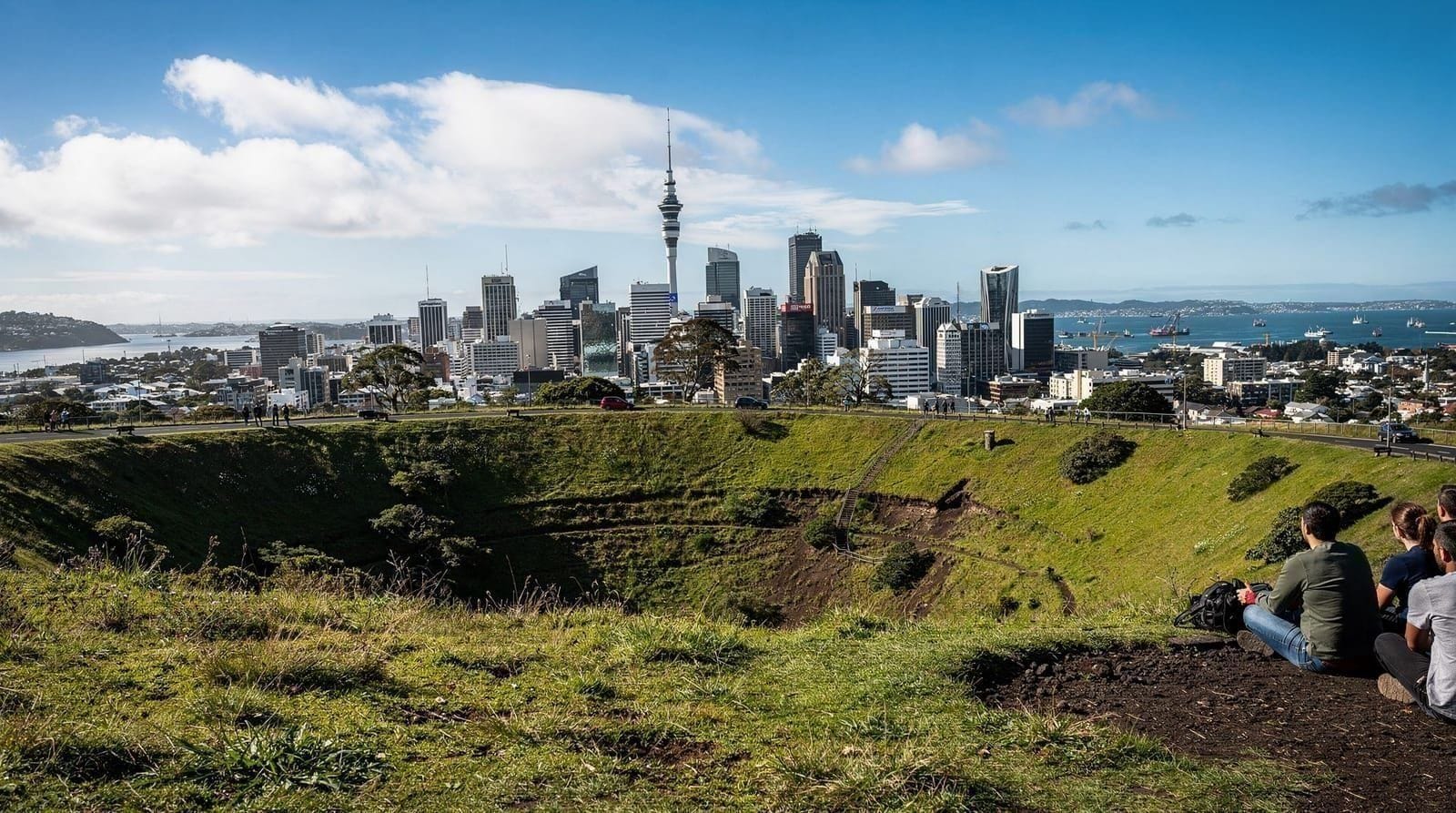
Public transport is a bright spot — the AT HOP card’s 20% discount and NZD 50 weekly fare cap make Auckland’s bus, train and ferry network cheap relative to comparable cities. Self-catering from well-stocked supermarkets is easy and effective for cutting food costs. And Auckland has a genuinely long list of free, worthwhile attractions: volcanic cone hikes with some of the city’s best views, most beaches (Mission Bay, Devonport, Piha, Muriwai), farmers’ markets, and large stretches of parkland. Our free things to do in Auckland guide rounds these up, and leaning on them can meaningfully offset an otherwise mid-range trip’s cost.
Day-trip tours, while not cheap in absolute terms, also hold up reasonably well on a cost-per-experience basis once you weigh what they include. A Hobbiton tour at around NZD 130 bundles return transport, guided access to a working film set, and a drink at the Green Dragon Inn — comparable, in structure and price, to a half-day guided experience in most Western tourism markets.
A Waitomo glowworm boat tour at NZD 45-80 is genuinely inexpensive for what amounts to a unique geological and biological experience unavailable almost anywhere else on earth. This Waitomo glowworm caves guided boat tour is a solid example of the value-per-experience point above. Judged purely on “cost per unique experience” rather than “cost per hour,” several of Auckland’s marquee day trips are better value than their sticker price initially suggests.
Is the cost justified by the experience
This is ultimately the more useful question than a simple expensive-or-not verdict. Auckland’s cost sits in the moderate-to-high band globally, but so does the quality of what it delivers: a safe, well-run city with a genuinely world-class museum collection, plus a day-trip radius — Hobbiton, Waitomo, Rotorua, Waiheke, the Bay of Islands — that’s difficult to match anywhere else for sheer variety within a two-to-three hour drive. Travellers who arrive expecting Southeast Asian prices will feel the gap immediately. Travellers who arrive comparing it to Australia, Western Europe or North America generally find the value proposition holds up, particularly once the day trips are factored in rather than judging the city in isolation. Our is Auckland worth visiting guide tackles this value question head-on, beyond the pure cost comparison covered here.
Common expensive mistakes worth avoiding
A few specific habits push an otherwise reasonable Auckland budget toward the expensive end without adding much value. Renting a car for the entire trip when it’s genuinely only needed for two or three day trips means paying for insurance and CBD parking (NZD 4-6/hour) on days when you’re exploring on foot regardless — a car booked just for the day-trip days, or a single multi-day rental timed around them, avoids this. Booking day-trip tours through a hotel concierge or an airport kiosk rather than in advance online often carries a built-in commission that pushes the price up 10-20% for an identical tour.
Eating every meal at sit-down restaurants in tourist-dense areas like the Viaduct, rather than mixing in supermarket self-catering or the CBD’s food courts and casual Asian eateries, is one of the fastest ways to inflate a food budget without a proportional increase in enjoyment. And travelling in peak summer without checking shoulder-season pricing first leaves real savings on the table — the same accommodation is routinely 20-30% cheaper just a few weeks either side of the December-February peak.
Currency, cards and avoiding unnecessary fees
New Zealand runs on the New Zealand dollar, and contactless card payments are accepted almost everywhere, which keeps the practical need for cash low. The one cost trap worth knowing about is dynamic currency conversion — when a card terminal offers to charge you in your home currency instead of NZD, it’s applying its own exchange rate, which is reliably worse than what your card issuer would apply. Declining that option and letting your bank handle the conversion is a small, free way to avoid quietly overpaying on every card transaction across a trip. A travel card or account with low foreign transaction fees is worth arranging before departure, since standard bank fees of 2-3% per international transaction add up meaningfully over a week or two of daily spending.
Does the season change the answer
Yes, substantially. Peak summer (December-February) sees the highest accommodation and tour pricing of the year, alongside the most crowded attractions — you’re paying a premium and getting a busier experience for it. Shoulder seasons (March-April, September-November) and winter (June-August) both bring noticeably lower prices, sometimes 20-30% down on hotels, without sacrificing much beyond a few degrees of temperature. Our best time to visit Auckland guide covers this trade-off in full, and it’s genuinely one of the easiest ways to make an “expensive” Auckland trip feel considerably more reasonable.
Does where you stay change the cost
Neighbourhood choice affects Auckland’s cost more than many visitors expect. CBD and Viaduct accommodation and dining carry a premium for walkability and waterfront position — a coffee or casual lunch in the Viaduct can run noticeably above the same order a 15-minute bus ride away in Ponsonby or Kingsland. Staying slightly outside the absolute centre and using an AT HOP card to get in is a genuinely effective way to reduce accommodation cost without sacrificing much practical access, since Auckland’s public transport network covers the useful radius well. Our where to stay in Auckland guide breaks down the cost-versus-convenience trade-off by specific neighbourhood, which is worth reading alongside this guide if accommodation is your biggest line item.
Managing cost perception day to day
Part of why Auckland feels expensive to some travellers and reasonable to others comes down to how spending is tracked, not just how much is spent. Because entry costs (NZeTA, IVL) and a chunk of accommodation and tour bookings are typically paid before or on arrival, the first few days of a trip can feel financially heavy even if the remaining daily spending settles into a comfortable rhythm. Separating one-off, pre-paid costs from genuine daily spending — rather than lumping everything into a single running total — gives a far more accurate sense of whether a trip is on budget, and tends to make Auckland feel less alarmingly expensive than an undifferentiated total suggests partway through a trip.
The verdict
Auckland is expensive relative to Southeast Asia and moderate relative to comparable Western cities — closer to Sydney than to London, and closer to a US city than to Bangkok. It’s not a budget destination, but it’s not a luxury-only one either: a disciplined mid-range traveller can manage NZD 250-350/day comfortably, and a genuinely budget-conscious one can get closer to NZD 100-150/day by leaning on free attractions and self-catering. For the full cost breakdown by category, see our Auckland budget guide and Auckland trip cost breakdown.
Packing to avoid on-the-ground purchases
A surprising share of trip cost creep comes from buying things on arrival that were easy to pack in advance — sunscreen, rain jackets, phone chargers and adapters all cost noticeably more from a CBD convenience store or tourist shop than from home. Our Auckland packing list covers what’s genuinely worth bringing versus what’s fine to buy locally, and it’s a quietly effective way to trim a few hundred dollars off an otherwise mid-range trip without touching the bigger line items like accommodation or day-trip tours.
Transport costs and how to keep them down
Getting around is one of the more controllable costs of an Auckland trip. Our getting around Auckland guide covers the full mode-by-mode breakdown, but the short version for budgeting purposes: the AT HOP card makes city transport genuinely cheap, while a rental car is only worth its cost on the specific days you’re doing a day trip that public transport can’t reach. Renting for the whole stay when you only need it for two or three days is one of the most common ways visitors inflate their budget without meaning to.
Comparing costs against neighbouring day-trip destinations
It’s worth noting that the day-trip destinations themselves (Matamata, Waitomo, Rotorua) generally run slightly cheaper than Auckland proper on food and casual dining, since they’re smaller towns without the CBD’s premium. This means a day-trip day, once you factor in the tour or fuel cost, doesn’t necessarily cost dramatically more than a city day once you account for the meals and incidentals you’d have spent in Auckland anyway — worth remembering if a day trip’s headline price feels like a big jump compared to a quiet day in the city.
First-timer cost mistakes worth knowing early
Beyond the specific traps already covered, a few smaller habits catch first-time visitors off guard. Skipping the farmers’ markets in favour of restaurant breakfasts every day adds up over a week, and not knowing which neighbourhoods run cheaper before booking accommodation means paying a premium without realising it. Our first-time Auckland tips guide rounds up the broader set of things that trip up new visitors, cost-related and otherwise.
Where to look next, by the kind of saving you want
Cost questions rarely stop at one guide, so here is how the rest of the site helps depending on which line item worries you most. If the day trips are the sticking point, our best day trips from Auckland guide lays out the options, and self-drive vs tour day trips helps you decide whether a guided outing or your own wheels suits your group better. The Hobbiton day trip from Auckland and the Waitomo day trip are the two outings most visitors weigh up first, and the Hobbiton and Waitomo combo shows how pairing them changes the picture.
If you would rather see the whole trip laid out before committing money, the 3 days in Auckland itinerary and the 1 day in Auckland itinerary show how much you can fit into a short stay without booking everything. Visitors who like a looser pace can compare them with the 2 days in Auckland itinerary, and our how many days in Auckland guide helps you decide whether extra nights are worth paying for at all.
Island and coastal outings are another place where choices affect the bill. The Waiheke Island guide and the ferry vs drive to Waiheke comparison explain how to reach the island sensibly, while Rangitoto Island offers a memorable outing that leans more on walking than on spending. For quieter ideas that rarely strain a budget, browse Auckland’s beaches and the volcanic cones of Auckland.
Finally, if you suspect some well-known attractions are not worth their entry cost, the Auckland tourist traps guide and the overrated vs underrated Auckland comparison are honest about where to skip and where to splurge. Our Auckland on a budget post collects practical habits from the same angle, and is the Sky Tower worth it tackles one of the most common spending questions head-on.
Frequently asked questions about Auckland’s cost of travel
Is Auckland more expensive than Sydney?
They’re broadly similar overall. Auckland often runs slightly cheaper on accommodation, while food and attraction pricing is comparable between the two cities.
Why is Auckland so expensive?
New Zealand’s remoteness increases import costs for goods, its tourism infrastructure serves a globally affluent visitor base year-round, and labour costs are relatively high — all of which push prices closer to Australia or the US than to nearby Pacific or Asian destinations.
What’s cheap in Auckland?
Public transport with an AT HOP card, self-catering from supermarkets, and a genuinely long list of free attractions — volcanic cone hikes, most beaches, farmers’ markets and parkland — keep costs down without much sacrifice.
What’s expensive in Auckland?
Restaurant dining, rental cars with insurance, and multi-destination day tours (Hobbiton, Waitomo, Rotorua combos) are the categories that push a trip toward the higher end, particularly in peak summer season.
Is it cheaper to visit Auckland in a different season?
Yes — shoulder seasons (March-April, September-November) and winter (June-August) both bring noticeably lower accommodation and tour prices than the December-February peak, sometimes 20-30% lower for hotels.
Is Auckland worth the cost?
Most visitors find it is, largely because of the day-trip radius rather than the city alone — see our is Auckland worth visiting verdict for the fuller picture beyond just price.
Do I need a rental car for the whole trip, or just some days?
Just the days you’re doing a day trip beyond the city, in most cases. Public transport and ferries cover a city-only itinerary comfortably, so renting only for Hobbiton, Waitomo or west-coast-beach days keeps costs down. See our getting around Auckland guide for the full breakdown.