Rotorua's geothermal activity, explained
Rotorua: Wai o tapu thermal park and lady knox geyser entry ticket
Why is Rotorua so geothermally active?
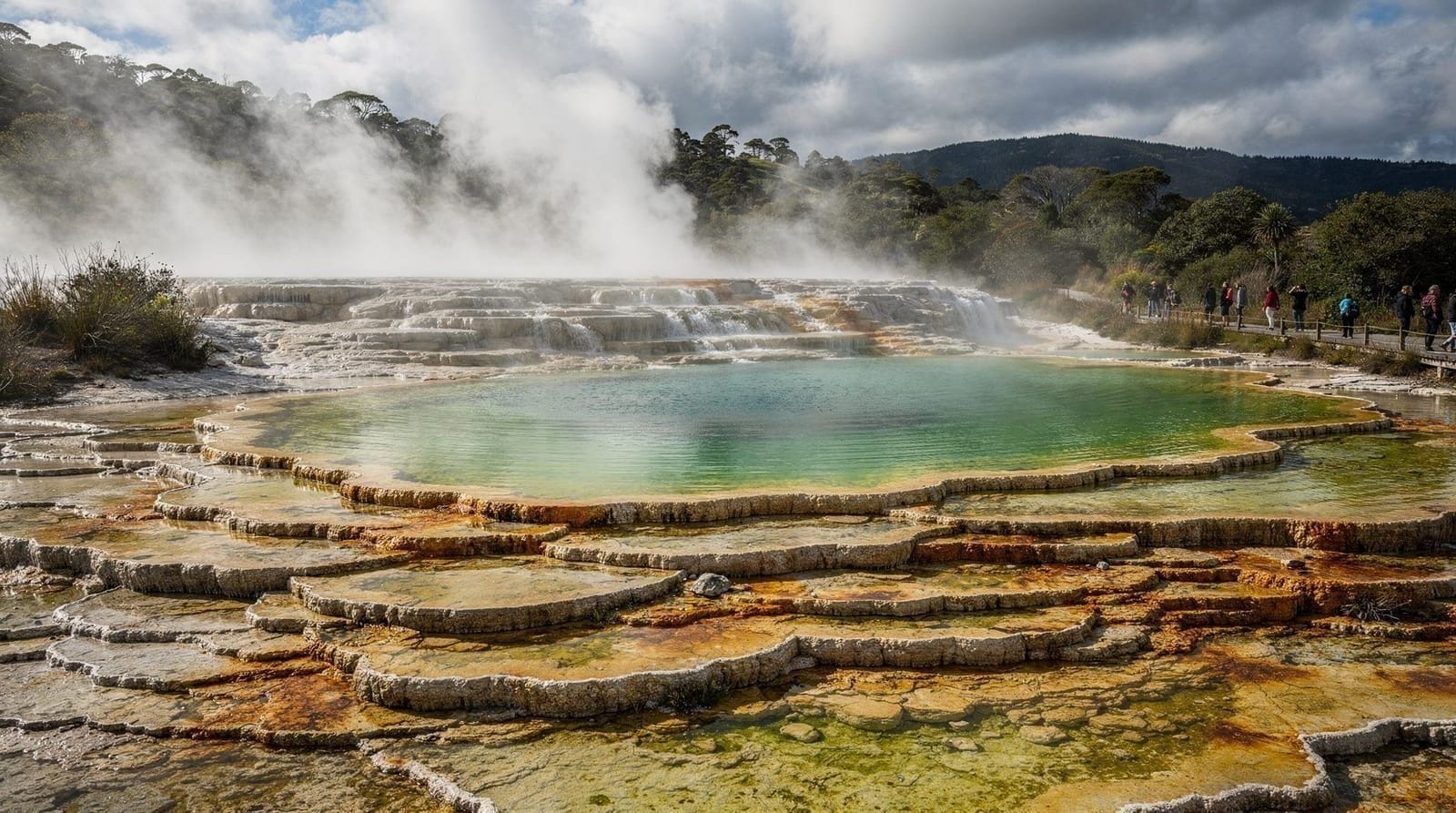
Rotorua sits directly on the Taupō Volcanic Zone, a band of active volcanic and geothermal activity running through the central North Island, where magma close to the earth's surface heats groundwater trapped in porous rock, producing the geysers, mud pools, steam vents and colourful mineral terraces visible across the region.
| Where | Taupō Volcanic Zone, central North Island, around Rotorua |
| Cost | Free to understand; park entry NZD 30-70 depending on which |
| Time needed | 5 minutes to grasp the basics before your visit |
| Getting there | See our Rotorua day trip guide |
| Best time | Any season — geothermal features aren’t weather-dependent |
Why Rotorua bubbles, steams and smells
Rotorua’s geothermal landscape — bubbling mud pools, steaming vents, colourful mineral terraces and periodically erupting geysers — is a genuine highlight of a North Island trip, and understanding roughly why it happens makes the visit considerably more interesting than simply photographing colourful pools without context. This guide covers the underlying science in plain terms, then walks through what you’ll actually see at each of Rotorua’s main geothermal parks.
The Taupō Volcanic Zone: the underlying cause
Rotorua sits directly on the Taupō Volcanic Zone, a roughly 350-kilometre band of active volcanic and geothermal activity running through the central North Island, from White Island (Whakaari) in the Bay of Plenty down through Rotorua and Taupo to Mount Ruapehu and Tongariro National Park. This zone exists because of the Pacific tectonic plate subducting (sliding beneath) the Australian plate off the North Island’s east coast, generating magma that rises closer to the earth’s surface here than in most other parts of the world. That magma doesn’t need to erupt as a volcano to produce visible effects at the surface — it simply needs to sit close enough underground to heat groundwater trapped in the porous volcanic rock above it, and that heated groundwater is what produces everything you see at Rotorua’s geothermal parks.
How a geyser actually works
A geyser forms when groundwater, heated by proximity to magma, becomes trapped in a narrow underground channel with a constriction near the surface. As the water heats past boiling point under pressure, it eventually flashes into steam faster than it can escape through the narrow channel, building pressure until it forces a sudden eruption of water and steam through the surface vent. Pohutu Geyser, at Te Puia, is a naturally occurring example, erupting up to 20 times a day without any human intervention — genuinely one of the more reliable natural geysers anywhere, given how irregular most geysers worldwide tend to be.
The Lady Knox Geyser: showmanship with a scientific basis
Wai-O-Tapu’s Lady Knox Geyser works differently, and it’s worth understanding the honest mechanics rather than assuming it’s purely natural. Each morning, park staff add a small amount of biodegradable soap to the geyser’s vent, which reduces the water’s surface tension and triggers a reliable, scheduled eruption — a practice dating back decades to when this trick was reportedly discovered by prisoners using the naturally hot pool for washing. It’s genuinely effective, entertaining showmanship built on real geothermal pressure underground (the soap triggers the eruption, but doesn’t create the heat or pressure that makes it possible), and a Wai-O-Tapu entry ticket including the Lady Knox Geyser timing is worth timing your visit around specifically for this reliably scheduled daily eruption.
Why the pools are so colourful
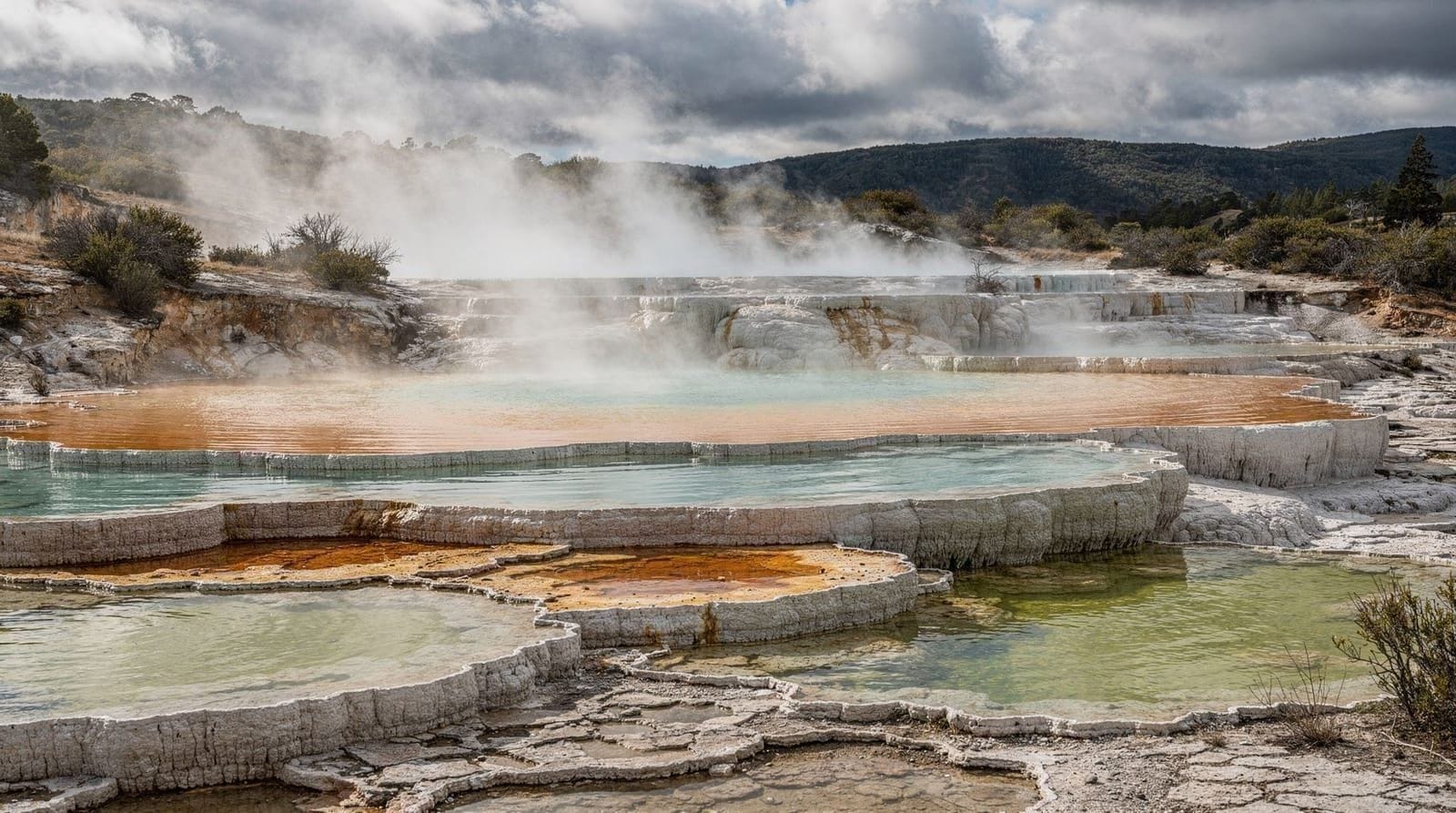
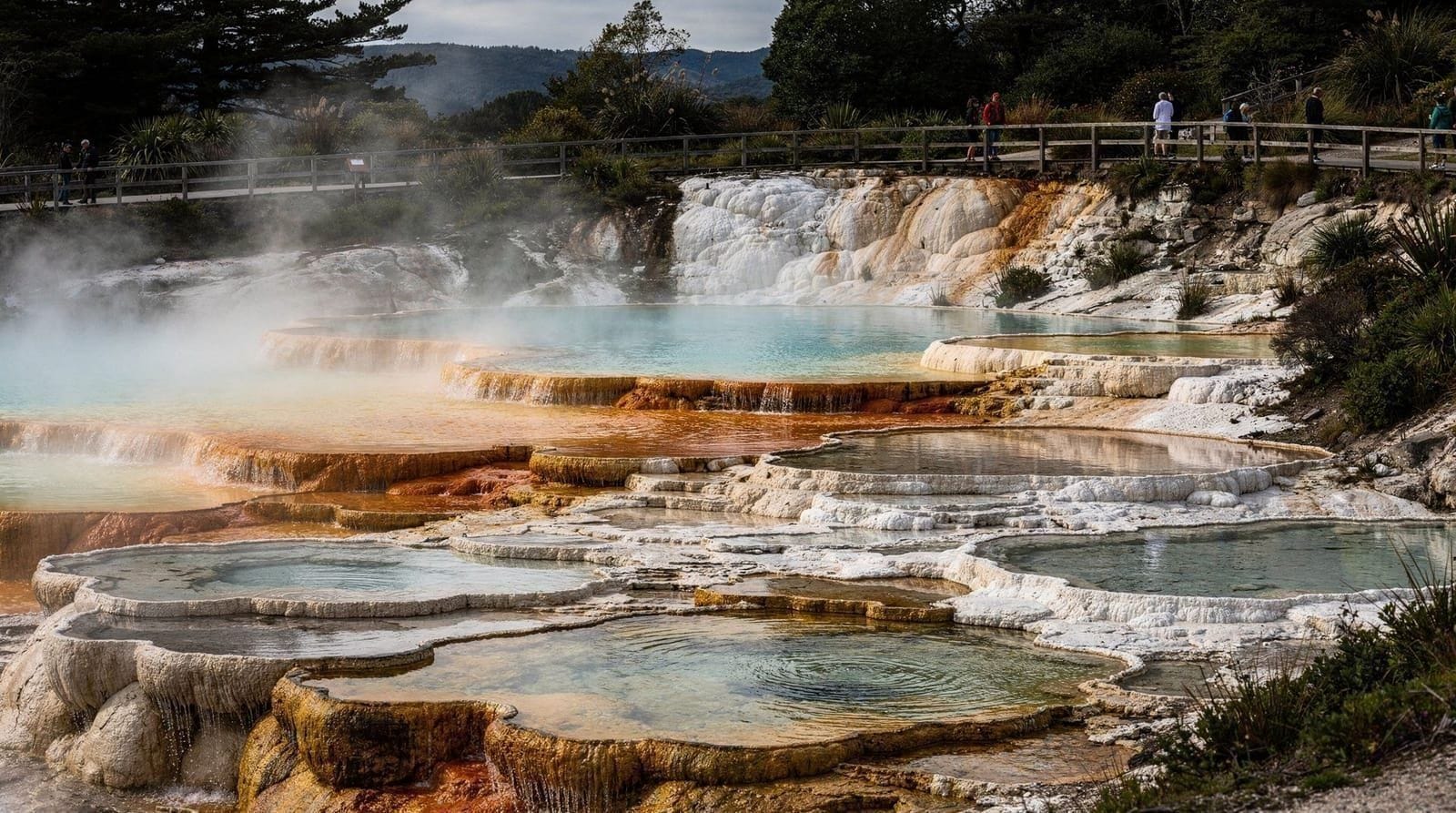
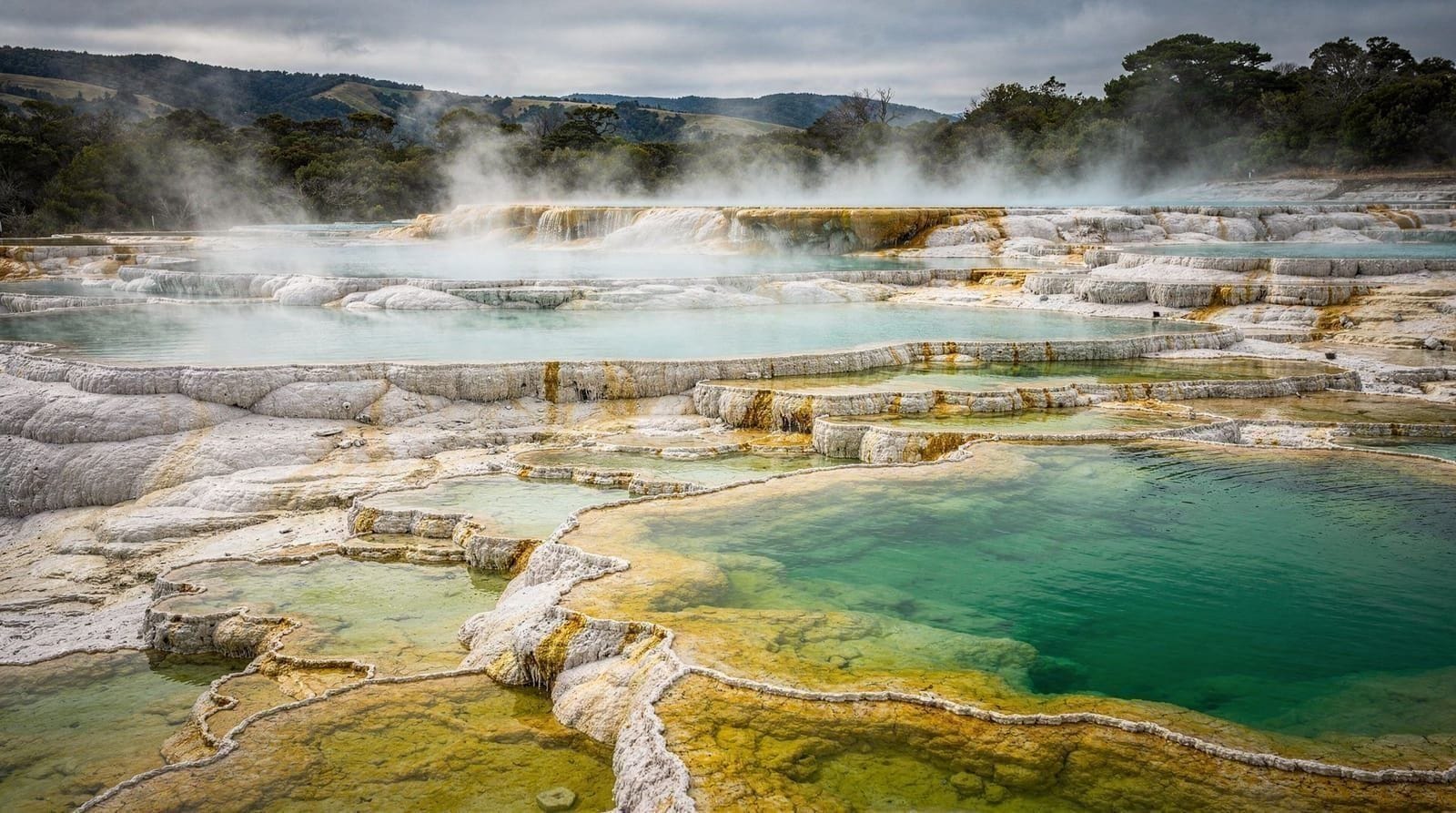
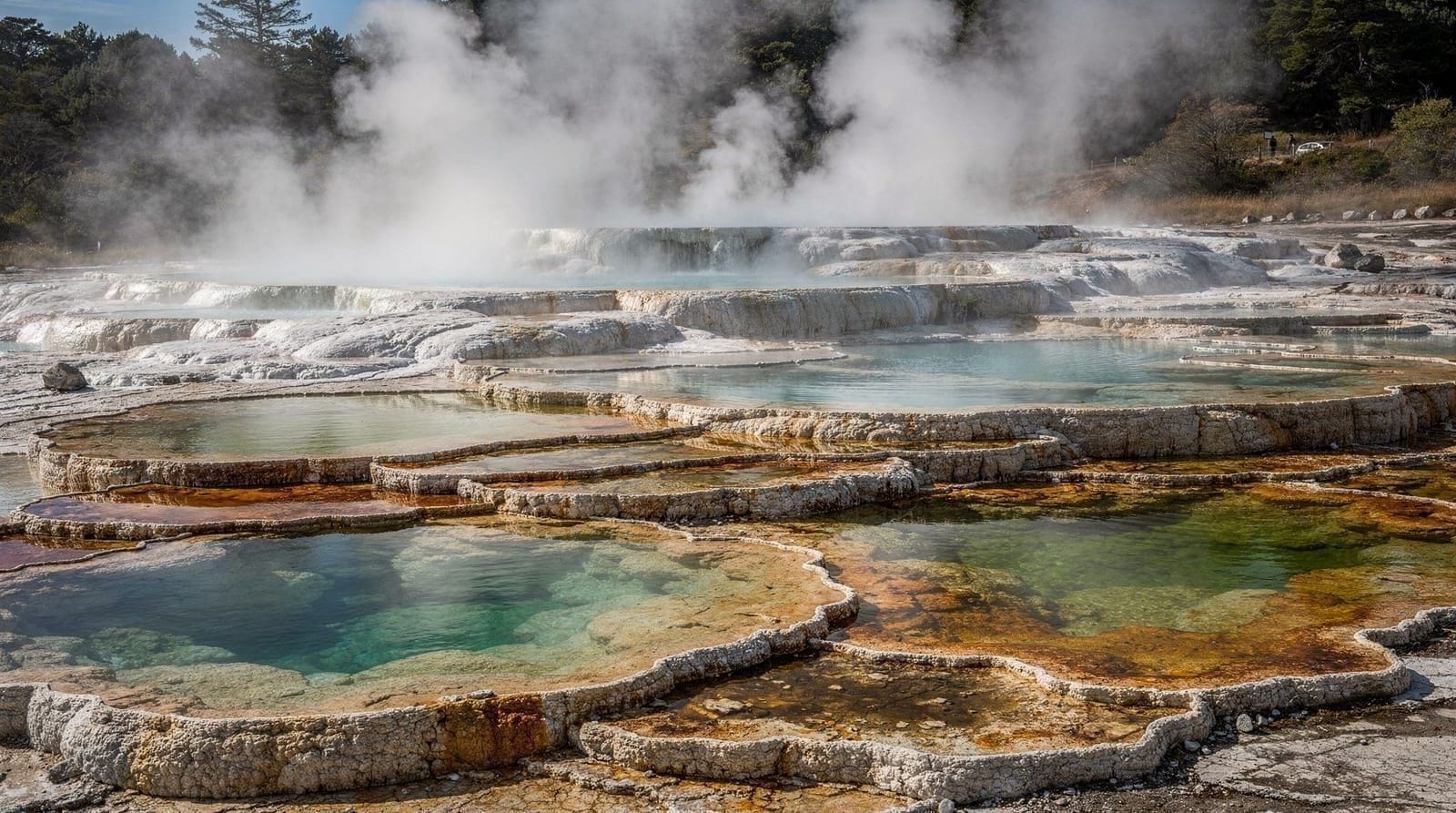
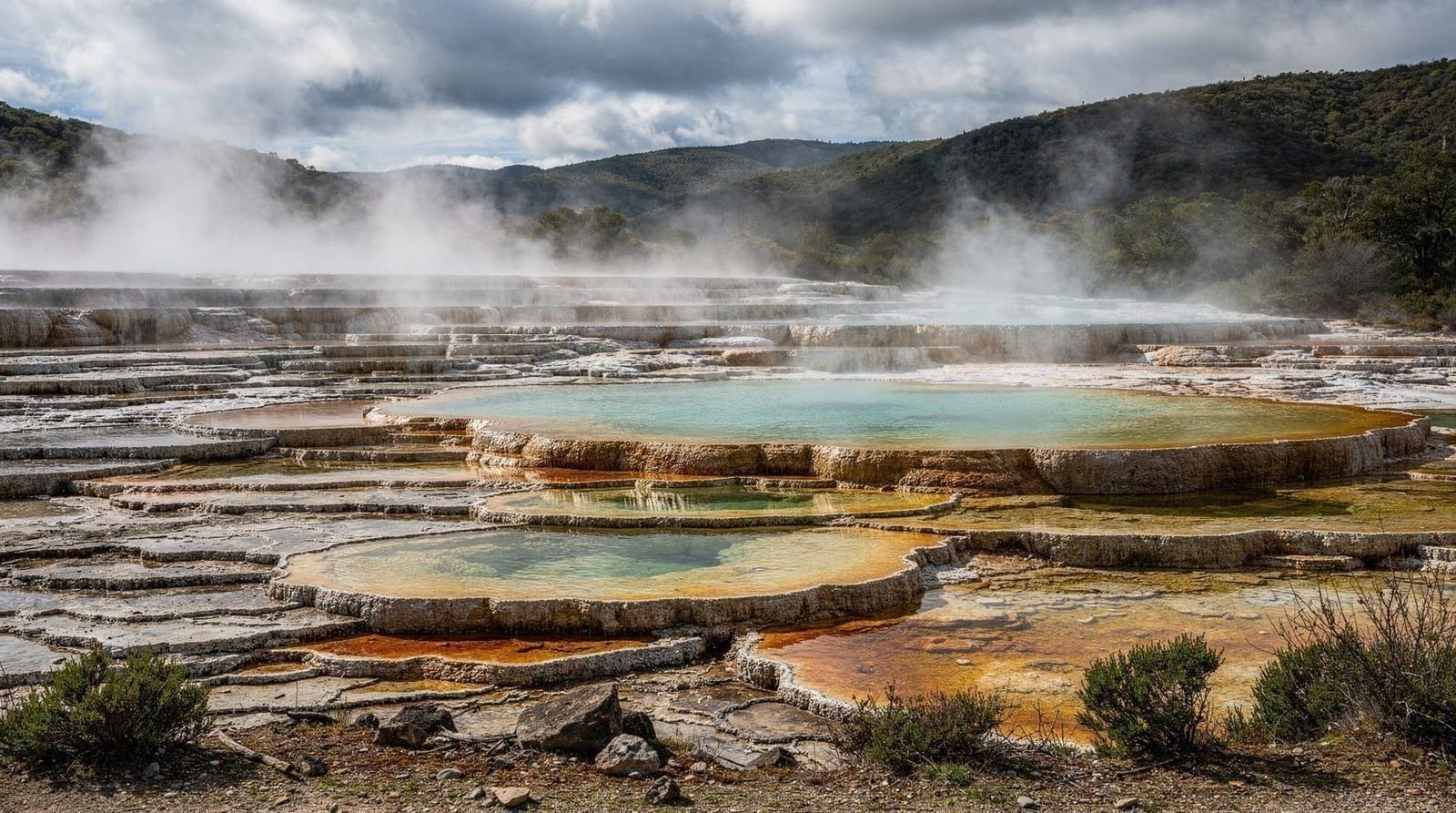
The vivid colours across Rotorua’s geothermal parks — the Champagne Pool’s orange rim, the Devil’s Bath’s bright green, various yellows and whites elsewhere — come from a combination of dissolved minerals, temperature and microorganisms reacting at the surface. The Champagne Pool’s distinctive orange rim specifically comes from precipitated antimony and arsenic sulphide minerals depositing as the water cools slightly at the pool’s edge, a striking natural chemistry lesson rather than an artificial effect. Elsewhere, sulphur deposits produce yellow tones, various algae and bacteria thriving in the mineral-rich warm water contribute greens, and silica deposits (the same mineral that once formed the famous Pink and White Terraces before their loss in the 1886 Tarawera eruption) create the white, terraced formations visible at several sites.
Mud pools and fumaroles: the quieter features
Not every geothermal feature is a dramatic geyser or colourful pool. Mud pools are bubbling pools of fine clay and water, heated from below by rising steam rather than fed by an active water source of their own — their consistency and bubble intensity shift with rainfall and underground pressure changes over time. Fumaroles are simply vents releasing steam and gas without any liquid water at all, often the hottest single points in a geothermal field despite looking quieter than an actively bubbling mud pool or an erupting geyser.
Seismic and volcanic monitoring today
New Zealand’s geothermal and volcanic activity, including the Taupō Volcanic Zone underlying Rotorua, is continuously monitored by GNS Science, the country’s government geoscience research institute, using seismographs and other instrumentation to track underground activity across the region. This is standard, ongoing scientific practice rather than a response to any specific elevated risk, and it’s part of why New Zealand is generally regarded as having some of the world’s more sophisticated volcanic and geothermal monitoring infrastructure, given how much of the country sits on or near active tectonic boundaries. For visitors, this monitoring is invisible in daily practice — it doesn’t affect how the geothermal parks operate day to day — but it’s worth knowing it exists as part of understanding how New Zealand manages living alongside this kind of ongoing geological activity.
Choosing which park to visit
Te Puia centres on the naturally erupting Pohutu Geyser and combines the geothermal valley with the New Zealand Māori Arts and Crafts Institute and cultural performances — the strongest single choice if you want geothermal science and Māori cultural context together. Te Puia’s guided day tour covers both in one visit. Wai-O-Tapu is purely geothermal but arguably the most visually dramatic, with the Champagne Pool and the scheduled Lady Knox Geyser eruption as headline sights.
Waimangu Volcanic Valley, the quietest and least crowded of the three, offers a different kind of visit entirely — formed by the 1886 Mount Tarawera eruption and now the youngest geothermal system in the world, walked as a one-way valley trail past craters, steaming lakes and colourful terraces with fewer crowds than the other two parks. A Waimangu Volcanic Valley entry ticket is worth considering specifically if a quieter, more nature-focused walk appeals over the more concentrated, crowd-drawing sights at Te Puia or Wai-O-Tapu. Our Te Puia vs Wai-O-Tapu comparison goes deeper into choosing between the two most popular options specifically.
The Pink and White Terraces: what was lost in 1886
No explanation of Rotorua’s geothermal history is complete without the Pink and White Terraces, once considered the eighth wonder of the natural world — vast, cascading silica formations near Lake Rotomahana, drawing visitors from around the globe in the mid-nineteenth century before the catastrophic 1886 eruption of Mount Tarawera buried them under volcanic debris and dramatically reshaped the surrounding landscape, creating the Waimangu Volcanic Valley visible today. The eruption killed well over 100 people in nearby villages and remains one of New Zealand’s deadliest natural disasters.
In recent years, sonar and exploratory research has suggested remnants of the terraces may survive beneath Lake Rotomahana’s waters and sediment, though their exact condition and any prospect of future access remain genuinely uncertain and actively studied. This history is part of why Waimangu Volcanic Valley, formed directly by that same eruption, carries such specific geological and historical significance beyond simply being “the quieter park.”
White Island (Whakaari): the same volcanic system, offshore
The Taupō Volcanic Zone doesn’t end at Rotorua — it continues northeast to White Island (Whakaari), an active volcanic island in the Bay of Plenty visible from parts of the region on clear days. It’s part of the same underlying volcanic system responsible for Rotorua’s geothermal activity, and historically operated as a boat and helicopter tour destination for visitors wanting to see an active volcanic crater up close, though access has been significantly restricted following a fatal eruption in 2019 that underscored the genuine, ongoing risks of visiting active volcanic terrain. It’s worth knowing about as context for the scale of the Taupō Volcanic Zone, even though it sits outside the scope of a standard Rotorua visit.
Safety on the boardwalks
Within any of Rotorua’s managed geothermal parks, the engineered boardwalks and formed paths are designed with visitor safety specifically in mind, and staying on them is the one rule that genuinely matters — the surrounding ground can be unstable, far hotter than it appears, and thin-crusted in places, so straying off marked paths is where risk actually comes from, not the geothermal activity itself when properly managed. Comfortable, closed footwear and sun protection (much of the walking is on exposed boardwalks with limited shade) round out the practical preparation for a visit.
Why Rotorua smells the way it does
The sulphur smell that Rotorua is famous (or notorious) for comes from hydrogen sulphide gas released as geothermal fluids reach the surface, most noticeable in specific pockets close to active geothermal areas — parts of the lakefront, near Te Puia and Wai-O-Tapu themselves — rather than a constant presence across the entire town. Most visitors report adjusting within a day and barely noticing it by their second visit to any given site. Our is Rotorua worth it guide weighs this and other practical considerations against Rotorua’s genuine highlights in more depth.
Fitting this into your Rotorua visit
Understanding the science behind what you’re seeing genuinely changes the experience from “colourful pools, good photos” to something considerably more engaging, and most of Rotorua’s geothermal parks include informational signage covering exactly this kind of context as you walk. Our Rotorua day trip from Auckland and Māori experiences in Rotorua guides cover the wider logistics and cultural side of a Rotorua visit if you’re planning a fuller trip around the geothermal parks themselves.
How Rotorua compares to other geothermal destinations worldwide
For visitors with some frame of reference from other geothermal regions worldwide — Iceland, Yellowstone in the United States, or Japan’s onsen regions — Rotorua holds its own distinctly, particularly for the sheer density and accessibility of features within a small, walkable area, and for the combination of geothermal landscape with genuinely deep, ongoing Māori cultural use of that same landscape, a pairing that’s fairly unique globally. Where Yellowstone emphasises wilderness scale and Iceland emphasises stark, otherworldly volcanic terrain, Rotorua’s parks are more compact and closely paired with cultural and historical context, making a visit here feel less like pure wilderness observation and more like walking through a landscape that’s been continuously understood, used and interpreted by the same community for many centuries.
Why understanding the science deepens the cultural side too
It’s worth connecting this geological explanation back to the cultural context covered in our Māori experiences in Rotorua guide — the same geothermal heat that produces the geysers and mud pools you’re photographing has been used directly by Māori communities in the area for cooking, warmth and bathing for centuries, including at Whakarewarewa Living Village, where residents still use natural steam boxes and geothermal heat in daily life today. Understanding the underlying geology doesn’t compete with that cultural context; it adds a complementary layer, explaining both why this specific location became such a significant, long-inhabited settlement site and why its geothermal features remain such a central part of the region’s living, contemporary Māori culture rather than purely a tourist backdrop.
Geothermal energy: how the same heat powers homes and greenhouses
The heat that produces Rotorua’s geysers and mud pools isn’t purely a tourist spectacle — the same Taupō Volcanic Zone geothermal resource powers a meaningful share of New Zealand’s electricity generation further south around Taupo and Kawerau, and locally, some Rotorua properties and greenhouses tap directly into geothermal bores for heating. It’s a useful bit of context for understanding that this landscape is a genuine, actively managed natural resource, not simply a photogenic backdrop maintained purely for visitors.
Where to go next once you understand the science
If this guide has made you curious about the wider region, the Rotorua destination page pulls together the main sights in one place, and adventure activities in Rotorua covers what to do beyond the geothermal parks. Travelling with children? Our Rotorua with kids guide explains how the boardwalks, steam and smells tend to land with younger visitors, and the sulphur and the erupting geyser are often the part they remember best.
Since the same volcanic zone continues south, Taupō and Tongariro National Park show other faces of the same system, and our Rotorua vs Taupō comparison helps you decide where to base yourself. If you are still deciding whether the trip is worth the time, Auckland to Rotorua transport options and the Auckland to Rotorua 3-day itinerary lay out how it fits around the rest of a North Island trip, while respectful Māori tourism is a useful read before you visit any site where geothermal land is also culturally significant.
Frequently asked questions about Rotorua’s geothermal activity
Why does Rotorua smell like sulphur?
Geothermal fluids carry dissolved hydrogen sulphide gas, released at the surface and producing the distinctive smell noticeable in specific pockets near geothermal activity.
How does the Lady Knox Geyser erupt on a schedule every day?
Staff add a small amount of biodegradable soap to the vent each morning, reducing surface tension and triggering a reliable eruption — effective showmanship built on real underlying geothermal pressure.
What causes the different colours in Rotorua’s geothermal pools?
Dissolved minerals and microorganisms reacting with heat and chemistry — the Champagne Pool’s orange rim comes from precipitated antimony and arsenic sulphides, while sulphur, algae and mineral concentrations produce other tones elsewhere.
Is Rotorua’s geothermal activity dangerous?
Within managed, boardwalked parks, no — staying on marked paths is what keeps a visit safe, since straying off them onto unstable ground is where genuine risk comes from.
What’s the difference between a geyser, a mud pool and a fumarole?
A geyser periodically erupts water and steam under pressure. A mud pool bubbles from rising steam without its own water source. A fumarole releases steam and gas without any liquid water.
How old is Rotorua’s geothermal activity?
The Taupō Volcanic Zone has been active for roughly two million years, though specific surface features shift over much shorter timescales, sometimes within decades.
Which geothermal park best explains the science as you walk?
Te Puia and Wai-O-Tapu both include detailed informational signage, and Waimangu Volcanic Valley’s one-way trail format lends itself particularly well to an unhurried, explanatory walk through its formation history.
Does Rotorua’s geothermal heat get used for anything besides tourism?
Yes — the same Taupō Volcanic Zone resource contributes to New Zealand’s electricity generation further south, and some local properties and greenhouses in and around Rotorua tap geothermal bores directly for heating.
Will I see the Pink and White Terraces on a Rotorua visit?
No — they were buried in the 1886 Tarawera eruption. Waimangu Volcanic Valley, formed by that same eruption, is the closest present-day equivalent, though sonar research suggests remnants may survive beneath Lake Rotomahana.
Top experiences
Bookable activities with verified prices and instant confirmation on GetYourGuide.